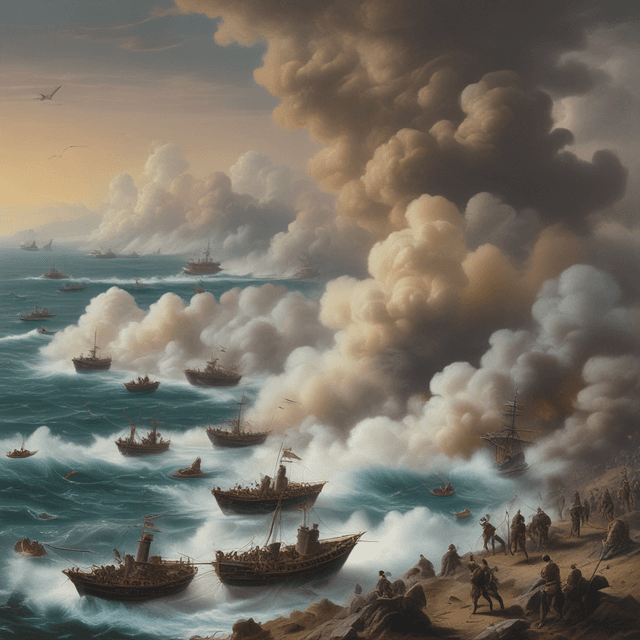
| Years | 1912 - 1914 |
| Causes | Control of Manchuria |
| Outcome | Inconclusive, weakened both empires |
| Conflict | Russo-Japanese War |
| Combatants | |
| Significance | Inspired nationalist movements across Asia, shaped the region for decades |
The Russo-Japanese War was a conflict fought between the Russian Empire and the Empire of Japan from 1912 to 1914. The war was primarily over the control of the Manchurian region of northeastern China, which both powers sought to incorporate into their respective spheres of influence. While Japan scored some early victories, the war ultimately resulted in a bloody stalemate, weakening both empires and inspiring nationalist movements across Asia.
In the late 19th and early 20th centuries, Russia and Japan emerged as the dominant powers vying for influence in East Asia. Both nations sought to expand their territories and commercial interests in the resource-rich Manchurian region, which was nominally part of the Qing dynasty of China but lacked a strong central authority.
Russia, seeking an ice-free Pacific port, had constructed the Trans-Siberian Railway through Manchuria in the 1890s and stationed troops to protect its interests. Japan, newly emerged as a modern industrial power after the Meiji Restoration, was determined to prevent Russian expansion that might threaten its sphere of influence on the Korean Peninsula. Tensions between the two empires came to a head in 1912 when negotiations over the status of Manchuria broke down.
Japan initiated hostilities in February 1912 by launching a surprise attack on the Russian Pacific Fleet at the Port of Arthur. This crippled the Russian naval presence in the region, but the land campaign that followed proved far more difficult.
The Japanese Army advanced into Manchuria, capturing cities like Mukden and Harbin, but met stiff resistance from the numerically superior Russian forces dug into defensive positions. The introduction of early armored vehicles, machine guns, and long-range artillery by both sides turned the battlefields into bloody stalemates reminiscent of the contemporaneous World War I in Europe.
While the land war descended into a grind, the naval conflict between Russia and Japan proved more decisive. The Japanese Navy leveraged its superior fleet, training, and access to emerging technologies like wireless telegraphy and naval mines to gradually wear down the Russians.
Major naval battles at the Tsushima Strait and in the Sea of Japan resulted in devastating losses for the Russian Pacific Fleet, all but eliminating its ability to project power in the region. Japan also deployed some of the world's first submarines and torpedo boats, forcing the Russians to adapt their strategies.
By 1914, both the Russian and Japanese empires were economically and militarily exhausted, unable to achieve a decisive victory. A negotiated peace agreement brokered by American President Theodore Roosevelt resulted in a return to the pre-war status quo, with Russia retaining nominal control of Manchuria but Japan gaining significant economic concessions.
However, the Russo-Japanese War had far-reaching consequences. In Russia, the military's failure and the economic costs of the conflict contributed to the growing social unrest that would culminate in the Russian Revolution of 1917. In Japan, the war's outcome was seen as a moral victory, bolstering the rising tide of Japanese nationalism and militarism.
Across Asia, the Russo-Japanese War inspired a new generation of nationalist leaders and independence movements, from Sun Yat-sen in China to Subhas Chandra Bose in British India. The demonstrated vulnerability of European colonial powers fueled aspirations for self-determination and the overthrow of imperial rule. This seismic political shift would reshape the region in the decades to come.
While the Russo-Japanese War was initially overshadowed by the cataclysmic World War I, it is now recognized as a pivotal moment that foreshadowed the decline of European empires and the ascent of Asian powers on the global stage. Its legacy of military stalemate, nationalist fervor, and technological innovation continued to reverberate through the 20th century.
